The Club » Managers
Joe Royle Nov 1994 - Mar 1997
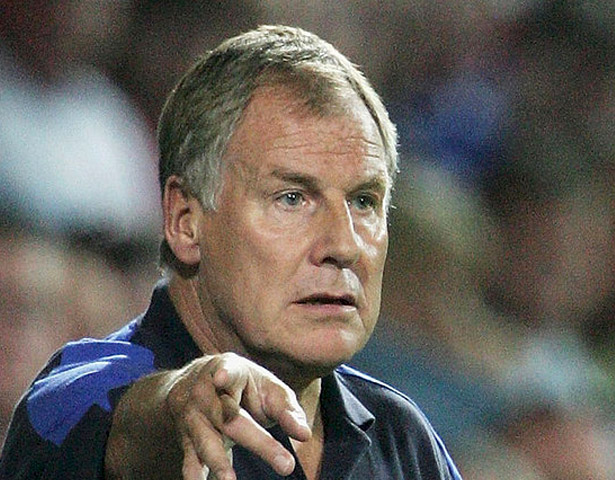
Joe Royle returned to Goodison Park in November 1994, hailed as a hero by the fans and the club he holds so dear to his heart. Mike Walker had led Everton to the brink of relegation in just 11 months and when Royle took over, the club was stranded at the bottom of the Premiership with just eight points from 14 games. Joe arrived on the back of 12 years of success on a shoe-string budget at Oldham Athletic where he led the Latics to the top flight, two FA Cup semi-finals and a League Cup Final appearance.
The story of how Joe then transformed the Blues almost instantaneously is legendary. In his very first match in charge Everton beat arch rivals Liverpool 2-0 with Duncan Ferguson scoring his first goal in the royal blue jersey and the recovery was underway. Three wins on the trot put Everton on the road to safety as Royle's men adopted the famous Dogs of War attitude.
Premiership survival was assured the following April alongside a remarkable FA Cup run that saw the Blues unrivalled spirit, determination and guile take them all the way to a Wembley triumph, seeing off Newcastle, Tottenham and Manchester United to lift the famous old trophy for the fifth time in their history. It was a quite remarkable achievement for a manager's first season in charge and he was lauded as the messiah who was going to lead the Toffees to emulate the golden period of the mid-1980s.
The 1995-96 campaign was a time of instability and rebuilding. The superb Andrei Kanchelskis was brought in from Manchester United but he was to spend six crucial weeks on the sidelines with a dislocated shoulder sustained, coincidentally, against United. When Kanchelskis was fit, Ferguson wasn't available, either through suspension or through injury. Then, a Glasgow jury found him guilty of assault for a head-butting incident while Duncan was at Rangers and the giant striker was to spend three months in Barlinnie prison. In his absence, the Royle revival continued and Kanchelskis went on to score 16 goals in 33 appearances during an electric spell after the New Year.
Unfortunately, the absence of these two stars meant that Everton struggled in the European Cup Winners' Cup and were eventually squeezed out by Dutch side Feyenoord – with future Everton boss Ronald Koeman in the lineup – by a goal to nil. Nevertheless, the side put together a run of games in the league that equalled the club's run of matches without conceding a goal and it seemed as though the building blocks were being put in place.
Some hiccups against the likes of Wimbledon and Leeds did enough to derail a challenge for a UEFA Cup place that eventually went to the wire and Everton missed out on the prized fifth position on goal difference. Dennis Bergkamp's 84th minute winner for Arsenal against Bolton on the final day of the season sent the Gunners into Europe at the Toffees' expense.
Nevertheless, optimism was as high as it had been for years during the 1996 close-season. Euro '96 came and went but the expected flurry of activity in the European transfer market never happened. The names of players like Russian midfielder Ilya Tsymbalar were bandied about in connection with Everton but Royle's first foray into the big league of transfer negotiations bore little fruit. Gary Speed was signed for £3.5m — another Evertonian coming home to roost — and Paul Gerrard arrived for £1.5m when a bid for Crystal Palace goalkeeper Nigel Martyn fell through at the last minute. Martyn, embarrassingly, was entertained at the headquarters of Park Foods in Birkhenhead, was shown the way to Leeds United and the Everton administration wound up with egg on its face.
And it was here that the cracks began to show. The beginning of the season again demonstrated just how much Joe Royle's Everton relied on spirit and confidence. The new season brought three encouraging results against Newcastle, Manchester United and Tottenham as the team found inspiration in the opportunity to build on the previous season that lay ahead. However, three consecutive defeats helped ruin that dream and — a 7-1 humiliation of Southampton aside — Everton failed to recapture the form with which they started 1996-97.
Christmas 1996 brought forth only bad tidings. Andy Hinchcliffe, Kanchelskis, Watson, Short, Parkinson, Grant and Ebbrell were all on the treatment table and a run of 7 games without a win between 23 December and 1 February, with an embarrassing 3-2 defeat at home to Bradford in the FA Cup thrown in for good measure, placed serious question marks over Joe's ability to lead his side out of its crisis. Failed bids for players like Carlton Palmer did little to inspire confidence and the performances deviated all too rarely from the route-one style of play that ultimately led to dissipation of the fans' faith.
The 2-0 defeat by Manchester United in a match the Blues had dominated so overwhelmingly was the last straw for many Evertonians who had previously supported Royle to the hilt. Perhaps the writing was finally on the wall and it took a disagreement with the chairman over transfers to make up Joe's mind that perhaps his time had come.
History has it that Peter Johnson refused to sanction the signing of Norwegian defender Claus Eftevaag — ostensibly a makeweight in a larger deal to acquire his striking compatriot Tore Andre Flo — after Flo himself turned down the move at the last minute. His ultimatum to Royle had the obvious consequence of the manager's resignation.
Johnson's view of this crucial episode was that, as the season continued, it was clear that Joe was getting panicky. While Joe had managed the club, Johnson had never questioned any of his signings but, just before the March 1997 transfer deadline, Royle informed Johnson that he wanted to sign Flo. In order to do so, he had to sign Eftevaag who was somewhat older and would cost £2m. Crucially, this all involved the Norwegian Agent that led to George Graham's demise at Arsenal...
Flo was playing for Norway at the Confederation Cup in Dubai and there would have been a real rush to get him signed before the deadline for £4m. Eftevaag failed a medical, but Royle still wanted to sign him as he really wanted Flo. So, faced with the guaranteed signing of a potentially unfit player and the non-guarantee of signing Flo, Johnson refused Royle for the first time.
Royle was shocked, walked out and came back 30 minutes later to resign. Johnson reluctantly accepted, later admitting that if he had persuaded him to stay, the club might have been relegated.
Royle's managerial legacy at Goodison will always be the dramatic fashion in which he turned a team from relegation certainties to top-6 challengers for Europe and, of course, the single trophy that Everton won in the 1990s.
Had his squad not been decimated by injuries in late 1996, who knows what might have happened, but fate intervened and Royle seemingly lost the plot. Dave Watson assumed temporary control and arrested the slide towards Division One and Joe went on to guide Manchester City from the Second Division to the Premiership in two seasons after a short spell away from football.
Royle would ultimately return home to Everton in a coaching and player-development capacity in 2014 where he worked alongside one of his former players, David Unsworth, and would co-manage the first team one final time, again at Unsworth's side, for the final match of the 2015-16 campaign following the dismissal of Roberto Martinez.
FactFile
| Born | Norris Green |
| Date of birth | 8 April 1949 |
| Nationality | English |
| Appointed | November 1994 |
| Joined from | Oldham Athletic |
| Left Everton (resigned) | 27 March, 1997 |
| Everton trophies | FA Cup, 1995 |
| Played for | Everton, Manchester City, Bristol City, Norwich City |
| Also managed | Oldham Athletic, Manchester City, Ipswich Town |
| » Wikipedia Entry |
Everton Premier League Record
| Season | Pld | W | D | L | GF | GA | Pts | Final Pos. | Win % |
|---|---|---|---|---|---|---|---|---|---|
| 1994-95 | 28 | 10 | 12 | 6 | 35 | 27 | 42 | 15th | 36% |
| 1995-96 | 38 | 17 | 10 | 11 | 64 | 44 | 61 | 6th | 45% |
| 1996-97 | 31 | 8 | 10 | 13 | 37 | 45 | 34 | 26% | |
| Totals: | 97 | 35 | 32 | 30 | 136 | 116 | 137 | 15th | 36% |
Everton FA Cup Record
| Season | Rnd | Pld | W | D | L | GF | GA | Win % |
|---|---|---|---|---|---|---|---|---|
| 1994-95 | F | 6 | 7 | 0 | 0 | 13 | 1 | 100% |
| 1995-96 | 4th | 4 | 1 | 2 | 1 | 8 | 8 | 25% |
| 1996-97 | 4th | 2 | 1 | 0 | 1 | 5 | 3 | 50% |
| Totals: | 16 | 10 | 2 | 4 | 21 | 18 | 58% |
Everton League Cup Record
| Season | Rnd | Pld | W | D | L | GF | GA | Win % |
|---|---|---|---|---|---|---|---|---|
| 1994-95 | - | 0 | 0 | 0 | 0 | 0 | 0 | - |
| 1995-96 | 2nd | 2 | 0 | 1 | 1 | 2 | 4 | 0% |
| 1996-97 | 4th | 2 | 0 | 1 | 1 | 3 | 4 | 0% |
| Totals: | 3rd | 4 | 0 | 2 | 2 | 5 | 8 | 0% |
Previous Management Record
| Season | Team | Pld | W | D | L | F | A | Pts | Win % |
|---|---|---|---|---|---|---|---|---|---|
| 1982-1994 | Oldham Athletic |
Previous Achievements
Second Division Championship – 1991
League Cup Final – 1990
FA Cup Semi-Finals – 1990, 1994

-sm.jpg)
-sm.jpg)
-sm.jpg)