|
EVERTON CHAIRMEN: Peter Johnson
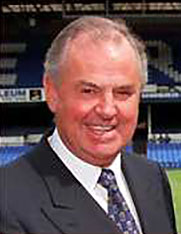
Chairman of Everton Football Club, 1994 – 1998 |
|
| The reign of Peter Johnson is finally over, much to the great relief of Evertonians who feel the club has been brought to the brink of ruin, shame and the humiliation of relegation by this ex-Liverpool fan. This compilation attempts to take a balanced look at Peter Johnson and the influence he has had over Everton Football Club, in what we shall term euphemistically as the Johnson Regime. | |
|
BACKGROUND |
Peter Robert Johnson,
57, estimated worth £120 M, was born in Liverpool and earned £3
a week working for his father, a pork butcher in Toxteth. He quietly
built up Park Foods from a Christmas club and hampers business and at his
Wirral headquarters the latest attempt to tickle our palates is flavoured
chips, DJ Spuddles Original Gourmet Fries.It was the strong local connection which took him into football in a serious way. He was a Liverpool fan and shareholder 'Once a red, always a red' is a valid gripe for staunch Evertonians and 10 years ago was asked to rescue Tranmere Rovers, the proud old club Wirral club in danger of extinction virtually on his doorstep in Birkenhead. He appointed former Everton player Johnny King for a second spell as manager and together they led Tranmere up from the foot of the old Fourth Division to the gates of the Premier League. They knocked a few times but failed to gain entry. King, now director of football at the club Johnson left behind to cross the Mersey for a bigger challenge in the summer of 1994, is proud of the partnership. But he has a salutary warning for Johnson, and anyone else tempted to cross the divide from big business to our national sport. 'Peter Johnson is a very strong man but football can bend the strongest at times,' said King. 'He's a friend of mine, a clever man, a good man, and he can be a good chairman for Everton. But this game is ruthless. If you don't get things right you have to take a bit of stick. 'I wouldn't have gone back to Tranmere to be manager for a second time if I hadn't been sure about him. People told me he meant business. It was different class than first time around. 'You need somebody behind you. I've always said you're as good as your chairman, although in fairness there was no reason that he should not have stood by me because we had success. 'He employed me to do the work. I lined up the players I wanted, set up the deals and when everything was ready asked him for a decision. He would say yes or no. It was a very, very good relationship, good chemistry, one of those things.' King, born in London but raised on Merseyside, started his playing career with Everton. 'Once a blue, always a blue,' he said. 'It surprises me that it's not gone better for Peter. I thought the relationship between Joe Royle and Peter would work. At the start it seemed as if it was going to be OK, particularly after they won the FA Cup, but you have to build. 'I know Peter was always feeling that he'd like to be captain of a bigger ship. Everton looked ideal for him. It's just that they've not quite sparked.' |
|
THE TAKEOVER |
After the glory days of the 1980's, the once-great Everton Football
Club had degenerated to a sorry state under the stewardship of Dr Michael
Marsh. Howard Kendall had returned in 1991 for a second spell at management
but left in November 1993 when the Board blocked the transfer of Dion Dublin.
The brash takeover by Park Foods hamper-business millionaire, Peter
Johnson, was finally completed in March 1994 after dragging on for months.
The uncertainty and lack of funds for new players was compounded by
Everton's anchor position in the table. But the arrival of Johnson was
seen as a new beginning, although to be fair there were voices of concern
raised by members of the competing consortium Peter Johnson was
not born a Blue:
The takeover came at an opportune time for Johnson. Everton shares were not highly valued, and Peter Johnson was able to leverage his sizeable wealth to gain a significant controlling interest with the outlay of around £10M. Even so, with relegation an odds-on bet as they entered that now legendary last game of the 1993-94 season against Wimbledon, Johnson was able to preside over a dramatic escape act as Everton avoided the drop. |
|
THE UPSWING |
If the Johnson Regime is to be ultimately castigated for the serious damage
done to the good name and fine traditions of Everton Football Club, it is
only fair to list some of the beneficial things that have been achieved during
Peter Johnson's reign:
The major task of the Chairman in the eyes of many fans is to underwrite a healthy transfer kitty that will keep a rich flow of talented players coming to Goodison Park. Johnson certainly played his part, with Daniel Amokachi, Duncan Ferguson, Andrei Kanchelskis, Gary Speed, Nick Barmby, and Slaven Bilic as the big-ticket transfers in a total outlay of more than £40 Million. Then came the return of Kendall and Johnson reportedly slammed shut the door to the vault... or so we thought. Johnson and others later claimed that it was Kendall's limited ambitions in the transfer market that were really to blame. Then came Walter Smith, and the contrast could not have been sharper. In came Olivier Dacourt. Marco Materazzi, John Collins, Steve Simonsen, and Ibrahima Bakayoko in a renewed £20M spree to revitalise the ailing giant. This apparent flushness temporarily eased the pressure on Peter Johnson, until an apparently unrelated event disturbed the status quo the resignation of Frank Corfe. |
|
THE FAUX PAS |
Despite the obvious improvements implemented in the name of commerce and
merchandising, loyal Evertonians found the Johnson Regime brought with it
a downside to contend with:
One or two such demonstrations of insensitivity could be tolerated, but the persistent ability of the Johnson Regime to make embarrassing, degrading or insulting decisions in the interest of merchandising wrankled more and more with an increasingly sceptical base of traditional Everton fans. Nil Satis Nisi Optimum was the club motto, but there was precious little evidence of that. The resignation of Frank Corfe as Chairman of Tranmere Rovers in September 1998 seemed to have little to do with Everton. But through Corfe's attempt to sell his 86% share in the club, it was revealed that Peter Johnson had picked up a £6M interest in Tranmere as part of a rescue bid to ensure the club's survival. Although significant financial interest in more than one club is apparently illegal under FA rules, Johnson has agreed with the FA that he can have until the end of 1998 to sort it out. |
|
THE TRANSFER OF AUTHORITY |
|
One puzzling aspect of the Johnson Regime is the apparent belief that it
knows more about the transfer of new players than anyone else, and has set
about proving this point in some extremely inept ways. It started off
reasonably enough, with Johnson the leading figure in bringing Duncan Ferguson
to Goodison, although perhaps against the wishes of then manger, Mike Walker.
To this list should be added the "acquisition" of a promised World-class manager in July 1997 the last Englishman to win a European trophy: Howard Kendall. A desperate 3rd choice after a long drawn-out snub from Bobby Robson, and a short, sharp snub from Andy Gray. In Gray's case especially, you have to wonder if it was the realization of having to drink from poisoned chalice offered by Johnson that shattered his personal dream of managing Everton. The belief amongst the fans has always been that Peter Johnson's primary purpose is to provide a continuous stream of cash to fund expensive and high-profile transfer deals. In reality, his function is more likely to underwrite the bank-loans needed to finance such deals, using as collateral his share-holding in Park Foods, Night Freight and / or Everton FC. This makes Everton's financial muscle in the transfer market vulnerable to volatile stock valuations and the recent financial performance of these companies. If the value of the loan collateral drops, the banks will no doubt put the dampers on further loans for big transfers, perhaps explaining the haggling over relatively small sums such as a few hundred thousand pounds in the case of the on-again / off-again Thomas Myhre transfer deal. |
|
THE BROKEN PROMISES |
Looking back, Peter Johnson's broken promises to the fans and the club seem
endemic. In reality, it was the Spring of 1997, and the following months
that stuck most firmly in the throats of increasingly desperate Evertonians:
The painful succession of broken promises deeply hurt loyal Evertonians who had trusted Johnson and given him the benefit of the doubt. After a summer of discontent in 1997, Everton Football Club had become something of a laughing stock, and the fault was clearly seen to lie at the feet of Chairman, Peter Johnson. By the summer of 1998, perhaps Johnson had learned his lesson; the crowing promises were replaced by silence from the club, as actions behind the scenes augured for a new beginning. Howard Kendall was replaced by Walter Smith, although many Evertonians believe this transition was shamefully conducted as a club legend was publicly humiliated . |
|
THE PROMISED LAND |
|
Perhaps the greatest "promise" produced by the Johnson Regime is the glittering
image of a New Goodison Park. At the last game of the 1996-97 season,
37,000 voting leaflets were distributed to the fans, asking them to vote
on the issue under the ultimate transference of authority in the
infamous Its Your Move brochure.
The vote proved to be a landslide for those in favour of a move: 18,374 with only 3,600 voting against... Odd, that round number? Well, take a look at this if you are the least bit paranoid about round numbers and possible vote-rigging: Everton FC Ballot Results 21/05/97 Closing Date 21/05/97
Batched Count
Move Stay Total
12 05 97 Monday
13 05 97 Tuesday 5150 650 5800
14 05 97 Wednesday 3800 650 4450
15 05 97 Thursday 2750 550 3300
16 05 97 Friday 1700 400 2100
17 05 97 Saturday - - 0
18 05 97 Sunday - - 0
19 05 97 Monday 2150 550 2700
20 05 97 Tuesday 850 150 1000
21 05 97 Wednesday 1974 650 2624
18374 3600 21974
83.62% 16.38% 100%
This information (from Everton FC) shows how the votes were counted each day. It is not clear whether this portrays the actual number of votes received each day, but the proliferation of round numbers seems a little odd. If the votes were counted in batches of 50, as the title and numbers suggest, isn't it odd that EXACTLY 650 "No" votes were left on the last day, giving a total of EXACTLY 3,600? The existence of such obvious and worrying questions serves only to reinforce concerns voiced by the Goodison For Ever-ton campaign about the validity of the vote, and cast an unflattering light on Peter Johnson's refusal to countenance independent scrutiny of the vote-counting process.
From a commercial perspective, the desire to move Everton away from its
century-old roots in the environs of Stanley Park centers on the promise
of financial benefits that go way beyond football. According to
the club, the full ground, conference and leisure possibilities include:
All of these are money-making enterprises. At the heart of the issue is money, plain and simple. The current revenue generated around Goodison Park on match-days through the season may be as much as £5M a year. Moving to a new location, away from the pubs and shops that surround Goodison and along County Road would redirect that money, and perhaps much, much more from car-parking and leisure activities a massive and sustainable windfall for the financial backers of the new enterprise. Although many fans would obviously love to see Everton playing in a brand new state-of-the-art stadium, the whole issue was clouded in serious questions for which the Johnson Regime had no substantial answers: |
|
Until these questions are answered to the satisfaction of the fans, there will remain a deeply held conviction that Peter Johnson attempted to railroad through his money-making liesuredome scheme under the tinsel wrapping-paper of a new stadium for Everton FC. As time goes on, the fans become less and less enchanted by Peter Johnson's vision for the club, and more and more concerned abut the damage he is causing in through a his lack of understanding and commitment to the REAL Everton Football Club. Time alone will tell if Peter Johnson's claimed love for the sport will eventually earn their respect. |
|
THE GATHERING STORM |
|
In November 1997, Johnson was first reported to be ready to sell his
68% stake. The club's media executive Alan Myers issued a denial, claiming
'the chairman and his directors are making strenuous efforts to obtain the
source of this misinformation'.
Seven days later the man himself said he was 'totally committed' and claimed he had rebuffed international financier Joe Lewis. The Lewis connections at ENIC then issued a denial. After the Chelsea defeat Johnson repeated: 'I'm not selling.' But the skeptics were not silenced. Rumours spread that Johnson would sell up before an expected stormy Annual General Meeting on 8 December 1997. Lord Grantchester, grandson of the late Sir John Moores and a director, was linked with a buy-out. However, he politely declined to shed any light: 'Any comments to be made should be made by the chairman on behalf of the board and the club and it would be improper for me to offer any comment on Press speculation,' but there is a strong feeling that he will join a consortium if the opportunity is presented. A fan for as long as he can remember, he is alarmed at the collapse of the club which became one of the major powers in the land under the patronage of his grandfather. 'Obviously, I am concerned at the situation – it's precarious at the foot of the Premier League. But I have confidence in the manager and his abilities,' he said in an interview with the national press before the December 8th AGM Howard Kendall, appointed for the third time in June 1997 after the farce of a long, unsuccessful search for the 'top quality, world class manager' promised by Johnson, has the support of most of the fans. They don't blame him because it has now become clear that he has little money to spend. They blame Johnson, who also promised before Royle's departure in March that the supporters would be 'pleasantly surprised' by the quality of the signings to come in the summer. 'I think the first thing the chairman and his advisers should do is to make strenuous efforts to find out where the misinformation regarding the buying of world-class players started,' wrote one dissatisfied customer. Cynicism has replaced credulity. Despair runs deep. Kevin Ratcliffe, captain under Kendall during the most successful period in the club's history two championships, the FA and European Cup-winners Cups in the mid-80s, summed up: 'It is a great concern to every Evertonian. The club have gone back years.' I've always said, even when playing, that anyone can win the FA Cup and you shouldn't get fooled by it. In the League you have to sustain it week in week out. Ratcliffe would love to have more to spend in his capacity as manager of Chester. 'Yes, I do feel envious of others,' he said. 'But millions have been spent at Everton since Peter Johnson took over. It's not been spent by Howard.' It's easier to judge a manager when he's spent money. 'If you sign players for millions you are judged on the results you get with those players. It's no good saying Everton are too good to go down. Look at Middlesbrough, they spent millions and were relegated. It's going to be very hard for Howard. The future is now.'
|
|
THE STORM ABATES |
|
The AGM turned out to be a moment of resolute triumph for Peter Johnson,
rather than the humiliation hoped for by many of his enemies. Firstly,
he put a time-limit on the meeting, and held the proceedings to his
agenda. Then, the traditional show of hands for voting in the
only returning Board Member, Sir Desmond Pitcher, went against him, so he
seized the moment to lock up the meeting for a good 40 mins in a paper ballot
which would always be decided by his vast shareholding.
In the end, the meeting was a big disappointment for the forces who would align themselves against the wealth and power of Peter Johnson. But they did have one important lesson reinforced. Peter Johnson owns a major controlling interest in Everton FC: he will not relinquish it lightly, and he has no intention of leaving until he is good and ready.
|
|
WHERE TO NEXT? |
|
Peter Johnson invested a large amount of money into Everton Football
Club. He also saw that investment produce a massive increase on paper
as the perceived value of the club climbed substantially during the mid-nineties
boom years for the Premiership. At its peak in the spring of 1998, his interest in the club
was estimated
to be worth about £80M to £100M.
As in everything with football, anything was possible, and nothing was certain. The nail-biting end to the 1997-98 season saw Everton hang on to the vital Premiership lifeline, but the calls for "Johnson Out" were widespread. However, the appointment of Walter Smith as the new manager, and a swath of exciting new signings definitely shifted the spotlight away from Peter Johnson for a brief respite... |
|
THE END CAME SWIFTLY... |
|
The date 30 November 1998 will be marked as a true red-letter day for thousands
of true-blue Everton fans: Peter Johnson announced his resignation as Chairman
of Everton FC, after a week of turmoil in the club. This followed directly
form Johnson's mismanagement of the transfer of Duncan Ferguson, which was
widely portrayed as having taken
place behind the back of team manager Walter Smith.
Of course, things are not always do simple in football. Peter Johnson believed that Walter always knew all about it and basically stitched him up. The reason for this is that Walter and Duncan had the same agent, and that Walter, who knew a thing or two about press manipulation, spun the story to his advantage. It does seem implausible that, if this was the case, that the agent hadn't told him about the deal The episode left Johnson genuinely aggrieved and badly bruised as an individual by his whole experience at Everton. He left the club a chastened man.
|
|
...OR SO WE THOUGHT |
|
Although he had resigned as Chairmen, Peter Johnson hung on for what
seemed like another lifetime as deliberations ensued over who would buy up
his shares... and for how much.
Meanwhile, in August 1999, the Premier League, the Football Association and the Football League joined forces to safeguard the integrity of their competitions in the wake of Peter Johnson's ownership of both Everton and Tranmere. The Premier League and the League gave permission for the situation to exist on the undertaking that Johnson's interests in one or both clubs was disposed of. The three authorities considered the circumstances surrounding the two clubs and whether their involvement in the Worthington and FA Cups would be appropriate. The authorities declared themselves satisfied that the corporate structure in place at Everton and the governance of Tranmere under chief executive Lorraine Rogers, provided a high degree of protection. But the authorities ensured the integrity of the arrangements by imposing three further measures:
When these conditions were met, both clubs were allowed to enter the
1999-2000 Worthington Cup. |
|
FINALLY!!! |
|
The deliberations dragged on for what seemed an eternity through the months of 1999 as it finally became clear that the only real contender for the purchase of Peter Johnson's shares would be Bill Kenwright. Surprisingly, it seemed that no-one else was interested. Well... surprising until you looked at how badly the club had been run for at least the last 10 years.... and how much in debt the club were to the Co-op Bank!
|
|
Last updated: 02 June 2006 |

Peter Robert Johnson,
57, estimated worth £120 M, was born in Liverpool and earned £3
a week working for his father, a pork butcher in Toxteth. He quietly
built up Park Foods from a Christmas club and hampers business and at his
Wirral headquarters the latest attempt to tickle our palates is flavoured
chips, DJ Spuddles Original Gourmet Fries.