


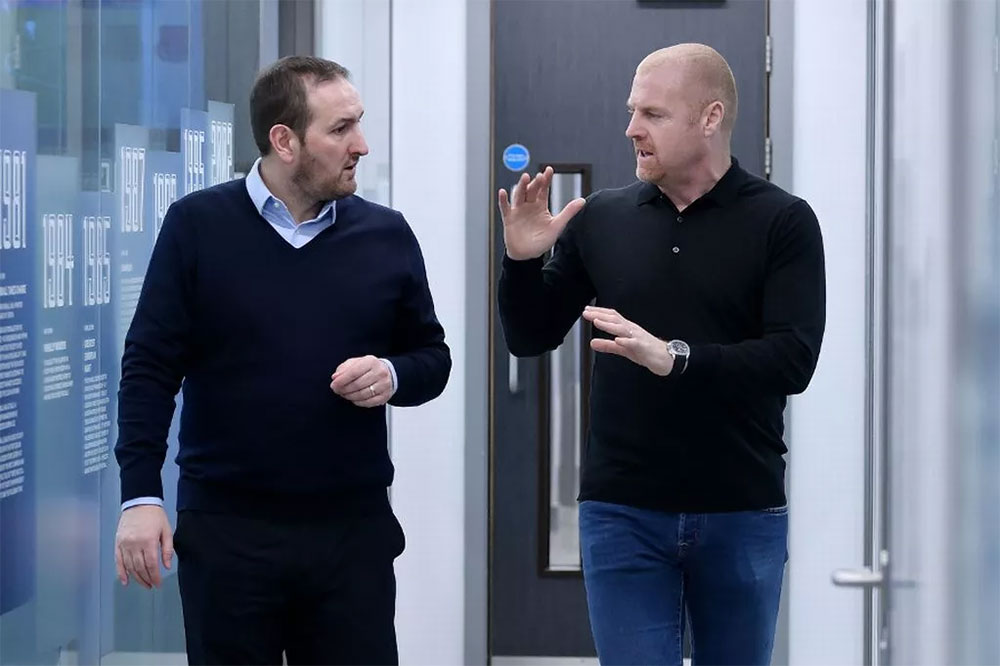
Whether talking to supporters in the street, scanning the ToffeeWeb comments section, or listening to blue-tinted podcasts, there is a certain sense of unclarity regarding our director of football, Kevin Thelwell.
Maybe it’s his unfashionable name – it’s been three decades now since Messrs Radcliffe and Sheedy had schoolboys dreaming of being called Kevin – or maybe it’s the fact that he looks more stand-in geography teacher than Premier League Svengali, but “the jury is still out” is the message coming across loud and clear from Blues.
It’s an opinion that, I’m going to argue, somewhat undersells KT’s achievements since joining Everton in February 2022 (does calling him KT make him sound any cooler? OK, didn’t think so…). In fact, when Dan and Ryan Friedkin hopefully take the reins at our illustrious institution later this year, I’d suggest that they’ll owe our Kev a giant debt of gratitude, and they won’t be the only ones. Not yet convinced? Then let me present my case.
A common-sense approach
As football fans, we’re in it for the passion, for the goals, for the moments that get you off your seats, that allow you to dream. However, those ups and downs need to remain on the pitch and not be allowed to spill off it. That was precisely the problem with the early Moshiri years. Big on promises, little on planning. It’s fun, but it’s treacherous and had the exciting proclamations and Hollywood signings of those years continued any longer, it’s entirely possible that Everton could have gone the way of Leeds, or worse.
To remedy this, we needed someone who could embrace the unglamorous elements of running a football club. We needed a steady hand, a common sense approach. We needed a stand-in geography teacher. Someone willing to patiently feed the chickens even as they were coming home to roost.
So, let’s cut to the chase. The headline statistic is this: no team in the Premier League has spent less than Everton over the past 5 years. Since Thelwell’s spell as DoF began, we’ve turned a profit through player trading. And let’s be crystal clear here – for Everton, that profit was what helped keep the lights on. Without it, the club faced a genuinely existential threat.
Here’s a quiz question for you. What do Tom Davies, Luke Garbutt, Jonjoe Kenny and Beni Baningime have in common? All came through the academy. All were thought to be promising talents. All gained senior team experience. And all left for nothing. For the sake of transparency, a couple of these players left in Thelwell’s first months as DoF but there’s not much he could have been expected to do with players in the last weeks of their contract.
However, contrast those departures with the likes of Lewis Dobbin, Tom Cannon, Ellis Simms and Ishé Samuels-Smith who, with just five starts between the lot of them, managed to fetch almost £30 million in transfer fees.
There is of course a separate conversation to be had about young talent and pathways but, if young players are going to leave, I for one would rather they leave for a fee. Like it or not, our neighbours across the park have this down to a fine art and fund some of their bigger purchases through the regular €10 million sales of young players who are good but just not good enough.
The funds brought in for the players I mentioned above (none of whom would walk into the current team, by the way) is greater than the amount Everton were charged with exceeding PSR limits by. Every penny counts when you’re in the position we’re in.
Head over heart
For too long, Everton has been run by the heart over the head. Of course we were; we were Bill’s Everton. Nobody ever questioned Bill Kenwright’s absolute love for the club, but it’s fair to speculate that that passion could have coloured some of his decisions in a business where there is no longer room for sentiment. That’s why academy graduates were given too long rather than moved on while they could still command a fee. That’s why a 32-year-old Wayne Rooney was given £160 grand a week and Don Carlo was given the club AmEx card and told to go wild.
Let’s be honest, under previous regimes, we’d have offered Dominic Calvert-Lewin whatever he asked for to sign a new contract this summer and we’d have thrown a ludicrous amount of money at a new contract for Dele Alli while we were at it. But Thelwell doesn’t make those mistakes. He knows what both of those players are worth and refuses to shift from that valuation. Would Dom signing a new contract be ideal? Of course. On Champions League wages with a questionable injury record? Hard decisions need to be made to steady this ship.
Losing Amadou Onana this summer was one of those hard decisions but, of all the unpalatable options available to the club this summer, it was the least bad thing to do. A player who wasn’t necessarily a guaranteed starter sold for a significant profit. The common-sense decision.
Whenever big teams like Manchester United have come sniffing around some of our most promising players in the past, previous DoFs and owners have turned into 1950s teenage girls, flicking their hair and kicking up a heel, all giddy and blushing with the idea that one of the big boys might notice little Everton.
This summer, Thelwell stood his ground professionally over Jarrad Branthwaite. He didn’t make unrealistic proclamations about Everton shooting for the Champions League, but neither did he roll out the red carpet. He let his head rule his heart – yes, you can have him but we (and the market) value him highly and we won’t shift from that valuation.
Cons as well as pros
Now, I haven’t said that Kevin Thelwell is perfect. There are a couple of striker-shaped elephants in the room for sure. Neal Maupay was an unmitigated disaster, as was the loan of Arnaut Danjuma, and we can only use the word “raw” for Beto for so long. But forwards are notoriously the hardest players to recruit for.
In the past few years, Gianluca Scamacca, Darwin Núñez, Cristian Benteke, Antony, Nicolas Pepe and Romelu Lukaku have cost Premier League clubs almost €500 million, while pitching in just over 30 league goals between them. None of them are bad players, but it goes to show how hard it is to get attacking signings right even when resources are endless; Kevin Thelwell went to the market with 2 packs of Quavers and an IOU written on the back of a fag packet. “Raw” was the result.
While it’s early days for both, Iliman Ndiaye and Youssef Chermiti have both shown enough to suggest that they can be very decent members of the squad, or better, going forward. And while it may be too early to really see the fruits of Thelwell’s labour in terms of the way he has restructured the academy and scouting networks at the club, I’d argue that recent signings like Ndiaye, Jake O’Brien and Onana, as well as ultimately unsuccessful moves for Mohammed Kudus, Adam Wharton and Jaden Philogene represent an enormous improvement in identifying talent and implementing a strategy to go after young up-and-coming talent.
The lack of full-back cover may also be a criticism aimed at Thelwell, although it’s a well-worn truism in football that building a team is like sleeping under a small blanket; you can cover your head or your feet but not both at once. At Everton, that blanket has been more like a dishcloth lately. I’d also argue that Sean Dyche carries some of the blame for this issue, particularly due to his reluctance to blood and trust young players in these positions.
If these are the negatives, there are some other positives we should also consider. Over the past three years, Everton have cut total player salaries from a shade under €2.5 million per week (a little higher than Spurs this season, for example) to just over €1.5 million per week this season, which is around the same as Palace and Fulham and the 11th highest in the Premier League.
I also think Thelwell should be applauded for being more transparent in terms of communication than previous incumbents of his position. The DoF shouldn’t communicate every week; their role is medium to long-term and I’d worry if he had a lot to say too often, but he has communicated clearly and openly with fans on multiple occasions through multiple channels and outlets.
The biggest mitigating factor through all of this is that he’s done it at the head of a rudderless ship with little to no support or backing from those above him. Everton have been operating to all intents and purposes without a board for the past 18 months. Many of us would argue that we were being run without an effective board for many years before that.
Whether you’re a fan of Kevin Thelwell, Sean Dyche and Interim CEO Colin Chong or not; whether the new owners keep some or all of them in situ, or choose to ring the changes and bring in new people, I’d argue that all Evertonians owe each of them a debt of gratitude. For the past few years, the three of them, with Thelwell at the forefront, have somehow kept level heads and steadied a sinking ship in spite of the icebergs all around.
Is this enough for me to rename my first-born Kevin? Maybe not. But our stand-in geography teacher has at least laid the foundations on which we can hope to build a better future.