


It’s been yet another transfer window where every penny spent and every transfer in or out feels more significant than we’d felt for a number of years. Gone are the days of David Moyes and his team striking harmony with cheap diamonds who consistently overperformed and formed a solid unit. Gone are the days where the track record of signings was strong enough to spread positivity within the fanbase, both for who we might buy next and what we might be able to do with more money at our disposal.
Through the numerous management structures we’ve seen under Farhad Moshiri, our recruitment has always seemed to be disjointed. Despite spending record amounts of money for our club, we’ve never looked more lacking in quality, mental strength, and squad depth than we have done in the last few seasons. Square pegs are squeezed into round holes just to form a starting eleven, sometimes with lineups consisting of players purchased by half a dozen or more former managers.
Many players have been purchased out of imprudence; a lot of money wasted on recruitment with no common direction. What resulted was a group of players who suit different styles, who cannot play to each other’s strengths and as a result, cannot effectively show their own.
The efforts of Frank Lampard in 2021-22 and Sean Dyche in 2022-23 to keep us in the Premier League, following the departure of Carlo Ancelotti and the disastrous reign of Rafael Benitez, were in many ways miraculous. We asked ourselves constantly throughout the past two dreadful seasons whether there are three worse football teams in the league than us, and every time it felt difficult to meet that number. Despite having spent so much money on our squad over the past 10 years, it is fair to say we are extremely fortunate to even call ourselves a Premier League team at the moment.
It was clear years ago that serious change was required to make relegation battles a thing of the past. We have relied so much on individuals who have given so little for so long, and the demands for improvement have been growing ever louder and fiercer. Every effort from the club to arrest the downward slide in the last few years has felt mediocre from the outset, and most inevitably turned out that way.
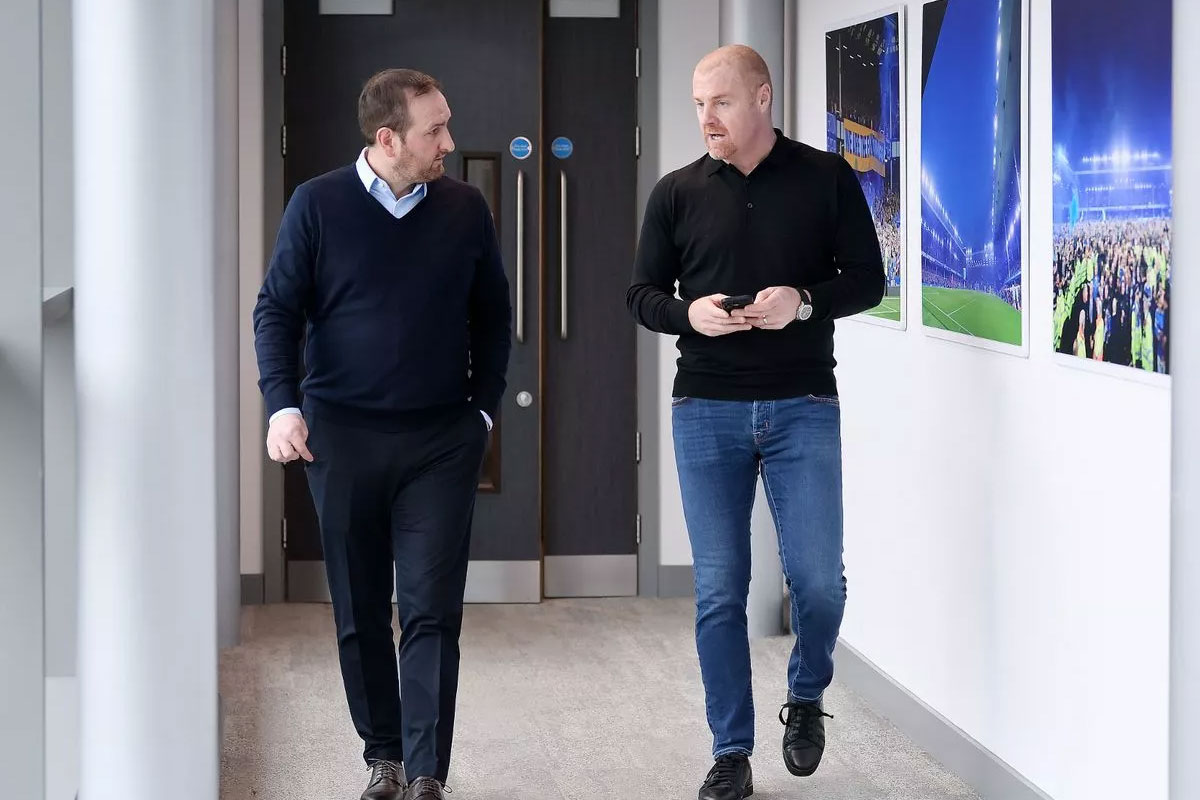
But one shining light from the depths of despair may well just be the appointments of Sean Dyche and Kevin Thelwell. With the former, he was handed the poison chalice upon his appointment at Everton this January, facing a squad which had been further weakened following the big-money departure of Anthony Gordon and not being able to recruit a single new addition.
The ex-Burnley manager had not even the slightest opportunity to adjust the dynamic of the personnel at his disposal, into something that resembled a squad he was remotely comfortable with. He went into one of the hardest battles of his managerial career unfamiliar with his men and without the tools he would have liked. Albeit by the skin of his teeth, he managed to scrape Everton over the line to safety, navigating us through a final game shootout to relegate Leeds Utd and Leicester City instead.
It may not have felt like progress on the surface to have a second relegation battle in as many years, both times missing the opportunity to lift ourselves out of danger with time to spare. But a big change was noticeable from quite an early stage even with the terrible squad he inherited – the instilled belief and desire to win, no matter the circumstances. It led to some critical points being salvaged against the likes of Tottenham Hotspur, Chelsea and Wolves and some hard-earned victories over Arsenal, Brighton and Bournemouth. I think a lot of Evertonians now believe in the ability of Dyche to encourage the correct mentality into his group which has been lacking for some time; however, that still has to go hand-in-hand with strong recruitment to fire us up the table.
That brings us to Kevin Thelwell. In many respects, his job was incredibly demanding, as the replacement to Steve Walsh and Marcel Brands under whom the recruitment was generally poor. The main challenge was the money available – with Everton in a Profitability and Sustainability stranglehold, it became clear that Thelwell and his team would not have the budget they’d have liked for the rebuild. But in theory, the job requirements should’ve been the same as with any other Director of Football role – recruit to improve.
While it is tough to suggest there has been a significant improvement in Everton’s overall transfer business under Thelwell, Everton’s internal transfer process has become much clearer under his reign. It has shed light on a glaring issue which likely contributed to the departure of Brands and potentially Walsh too. Put simply, Farhad Moshiri has too much influence. Whether it’s rubbing shoulders with superagents like Kia Joorabchian or recruiting out of impulse and sentiment, an owner with next to no football knowledge has taken disproportionate control of our on-field business.
It isn’t likely to just be Moshiri at fault – chairman Bill Kenwright has been the common denominator in our struggles throughout the entire Premier League era. It’s clear he has a larger part to play in player recruitment than most football club’s board members as well, and as mentioned earlier, I think sentiment in particular is very important to him. But romanticism and sympathy gets us nowhere; we have to recruit individuals who improve the direction of the team and not just those who are liked by the people at the top.
This season, we seem to have seen a slight shift in the right direction. Whether this is Dyche’s influence or Thelwell finally finding his voice, we seem to be more coherent and stubborn with recruiting certain targets, some of whom had even previously rejected us. The recruitment in this window seems to be starting to fill some of the gaps within the squad that have been glaringly obvious for years, and also starting to mitigate some weaknesses like pace, crossing ability and goalscoring.
Maybe it doesn’t feel overly wise bringing in players like Arnaut Danjuma, who u-turned on a deal in January, journeyman Ashley Young, or inexperienced youngster Youssef Chermiti; however, I think it makes progress in restoring some balance and reliability within the team. It gives us enough short-term encouragement while also giving us some space to think about the future and develop talent in-house.
There is still significant work to do and possibly too much to realistically achieve in a single window; however, the combination of Dyche and Thelwell finally appears to be buying with a plan, piecing together a unit that gives us an identity that the manager likes. They also seem to have pacified Moshiri to an extent where they can retake control of the business they are there to perform. They seem able to pursue targets they are scouting without being rebuffed by the ones handling the money. While there is still obvious interference, cases of it seem less frequent.
Will it mean we see an instant improvement in results? Possibly not. The whole operation will take time, and that’s why I’d encourage all Evertonians to exercise patience. That phrase has been said too many times in recent years and we’ve been more than patient enough, but I do think the light at the end of the tunnel is brighter right now with the promising signs we’ve seen recently. For now, we have to give the manager some space to breathe.
It is obvious that our past few managers have been dealt bad hands and as such their performance is difficult to measure. But I think we can all agree that Dyche has brought something a little bit different, a little bit more promise and a clearer idea of how we want to play. We must stick with a managerial structure for a sustained period to restore some normality and establish a baseline to work forwards from. On recent trends, I think Dyche and Thelwell warrant being the men to be given that confidence and support more than their predecessors.