


Column
It may be the most popular, most marketable and most lucrative domestic league in world football but the Premier League is, in many ways, broken. It’s floundering implementation of Video Assistant Referees is eroding the very spirit of the game and it ceased to be a sporting competition, in the true sense of the word, years ago.
Ever since Abu Dhabi United Group fundamentally altered the landscape with its almost unfathomable buying power and crystallised the era of mega-billion pound institutional and sovereign ownership, England’s top flight has been an exercise in futility for all but a select group of increasingly rich and powerful clubs.
Ironically, perhaps the most thrilling story of the Premier League era wasn’t Manchester United edging Arsenal to the title by a point in 1998-99 on their way to the treble, Manchester City’s first petro dollar-fuelled title win in 2012, or the same club’s hair’s-breadth triumphs over Liverpool in 2019 and 2022, but Leicester City’s 5,000-1 miracle Championship win in 2016.
That improbable achievement, on the back of a narrow escape from relegation the previous season, was unlikely but feasible during the first century of the professional game in England; back then, it was possible to come up from the second tier and win the league the next season, as Everton did in 1931-32. It was also the event that many cite as the catalyst for the moves made by the so-called “big six” over the past few years to consolidate their stranglehold on both the major domestic honours and entry to the Champions League.
First came Project Big Picture, a cynical power grab led by the Northwest’s two red giants, in October 2020 and then there was the even more Machiavellian European Super League(ESL), an attempt by the six most powerful clubs in England to pull the ladder up behind themselves and ensure that no club could ever “do a Leicester” and deprive any of them either the title or a place on the Continent’s gravy train again.
While not a move designed to immediately break away from the Premier League, the ESL would, nonetheless, have led to the destruction of domestic football over time by ensuring that these six clubs’ revenues would dwarf those of the other 14 in the top flight to such a vast degree as to render the concept of competition even more meaningless than it was becoming.
When you raise the issue of the ESL with fans of the “Shameless Six”, some point to the fact that Everton were once part of an elite cabal of clubs who, in the name of self-interest and consolidating wealth at the top of the domestic game, ushered in the Premier League in the first place in 1992.
This is, of course, true — as one of the old “big five”, Everton did lead the push for the creation of a new league, separate from the old Football League. But no one could have foreseen back then extent to which the monster they helped create would mutate from the globe’s oldest and best sporting competition into an inequitable business playground and sports-washing enterprise for super-rich moguls, oligarchs and sovereign wealth funds. It is, as they say, relative; what was envisioned in 1992 is a far cry from where we are now.
The inception of the Premier League lured in the cream of the world’s footballing talent and made England’s league the most popular and exciting in the game, but the trade-off has been the gradual but ever more drastic tilting of the playing field towards those clubs fortunate enough to have been at the top when the real money was being made (or pumped in, as was the case at Chelsea and Man City).
Had the likes of Sir Phillip Carter known the extent to which the spirit of sporting competition would be eroded over the subsequent three decades, they might well have paused for thought on their grand venture. With the benefit of the hindsight available to us, they might have tried to build in the safeguards that are belatedly — but cack-handedly — being applied now by an institution petrified of an independent regulator.
Neither Everton’s unmatched membership of the top flight since 1888, nor the part the club played in the formation of both the original Football League and Premier League 104 years apart, has afforded them any special dispensation, as is right. Sadly, as was seen when the six ESL rebel clubs were punished with a paltry £22m fine between them (largely because no mechanism existed at the time to formally charge and censure them), the same standard isn’t applied to others.
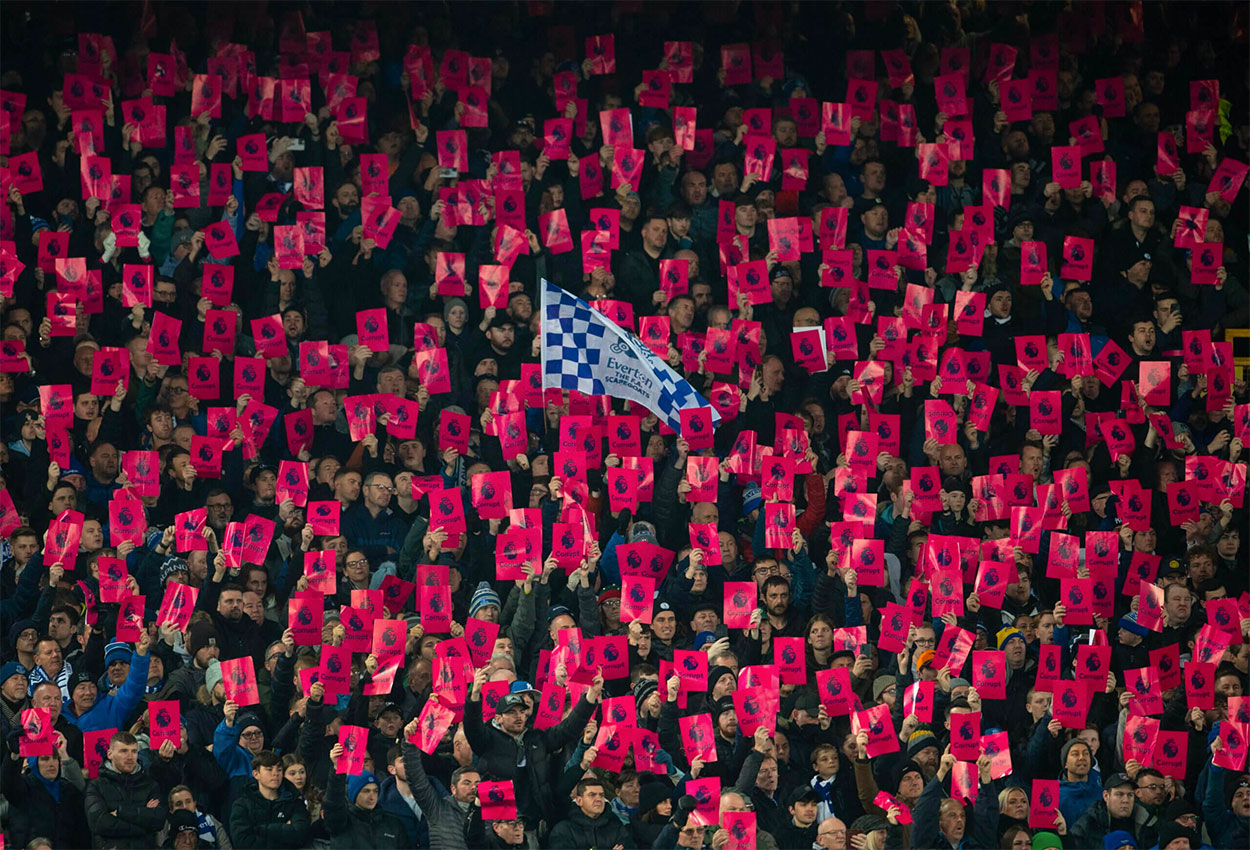
The shockingly harsh 10-point penalty meted out to Everton this month for violating the Premier League’s Profitability and Sustainability Rules (PSR) perhaps succinctly illustrates the Blues’ standing in the modern game – big enough to be made an example of as a warning to others but not big enough to disrupt the “big six” power bloc and the newcomer to the banquet table, Newcastle United.
Thankfully, the outrage from much of the footballing world, and a select band of pundits, high-profile journalists and politicians who agree that the sporting punishment was massively disproportionate to the financial crime and smacked of over-reach by an organisation with both eyes on the threat of the aforementioned independent regulation has been robust and vocal.
It couldn’t possibly match the anger felt at Everton, however. Even allowing for the scandalous and ill-timed revelation that the Premier League had “adopted a sanction policy that it considered to be appropriate to breaches of PSR” as late as August and were seeking a heavy 12-point deduction before the “independent” commission had even finished deliberating, the club were said to be stunned by the panel’s verdict. Despite their well-founded cynicism and distrust of the League, Toffees fans were equally shell-shocked by a ruling that erased 10 points from Everton’s tally for the season and dumped them into a third successive battle against relegation.
It made a mockery of the very intent of the rules that the Blues were adjudged to have broken – by taking away 10 points, a larger deduction than the one handed down to Portsmouth for actually going into administration, the commission’s decision might not only have effectively fined the club as much as the £20m by which they broke the spending threshold (every place in the table is worth around £3m) but threatened Everton’s very existence to boot.
The club’s accounts for 2021-22 contained the alarming note that relegation to the Championship would challenge Everton’s ability to continue as a going concern given the debts that have been run up under Moshiri’s auspices and his inability to keep throwing money around. Even if the Blues stay up, any ruling that permits any of the recently relegated clubs to sue them for damages could also send them under.
The decision to refer Everton to the commission in the first place was galling, firstly, given how closely the club has worked with the League since the summer of 2021 on all of its transfer dealings. Richarlison was sold in order for the club to remain PSR compliant; Moise Kean’s and Anthony Gordon’s departures for a combined £73m brought Everton’s budget deficit down considerably; and other top-flight clubs were told in May 2022 that the Toffees had no case to answer for where PSR was concerned.
Secondly, because, as Ian Herbert pleasingly highlights in his article for the Daily Mail, the Premier League “moved the goalposts” on Everton in the middle of the rolling three-year period under consideration by disallowing the deduction of interest on loans associated with the construction of the new stadium.
As Herbert asserts, “Everton were given the very distinct impression that the cost of interest on loans to build their Bramley Moore Dock Stadium would be excluded from sustainability considerations, just like [Manchester] City’s.” He also rightly points out that six other clubs (including another gifted a tax payer-funded stadium, West Ham), “had been able to keep them out of the financial calculation and that this was an investment in the long-term future of a club and its city”.
Indeed, what could be more beneficial to a club’s long term sustainability than a new stadium with an increased capacity to drive the revenue to enable them to compete with richer clubs already playing in larger arenas and/or blessed with more advantageous socio-geographic circumstances, like those playing in the wealthier environs of London?
And yet, despite all that; despite the club admitting it’s guilt on one single charge, albeit with a number of mitigating factors; despite the commission agreeing that Everton did not wilfully break the rules to gain sporting advantage; despite the club bending over backwards to trim the wage bill and rein in their spending with complicated deals involving little to no money up front, they were still found to be in breach of the spending threshold to such an extent that it warranted a 10-point penalty.
Everton will lodge their appeal by this Friday and, hopefully with the continued backing of the media and tenacious politicians like Andy Burnham, enough pressure will be brought to bear that the new panel that assesses the club’s claim will see fit to either reduce or erase the points sanction on the basis that it was overly harsh.
No one of a Blue persuasion will be holding their breath and, if the 10-point penalty is upheld, it would stand as a punishment that hits the supporters the hardest, those most innocent of all. Indeed, the pointed irony of the whole situation is that there was criticism from many parts of the fanbase at the outlandish spending and lavish salaries splashed through much of the Moshiri era and a growing band of Everton fans have been protesting the very mismanagement from the top that got the club into hot water in the first place. What’s worse is that all but one of the culprits is gone, with Moshiri having one foot out the door himself; the can for past misadventures will be carried by those who played no part in them.
In the meantime, the fight for Everton’s survival will continue on the pitch. Manchester City, with their army of lawyers, will continue to obfuscate and obstruct the Premier League in their attempts to nail them on any number of 115 separate charges. The football world will wait to see if Chelsea will ever feel the ramifications of bending spending rules to breaking point in recent years with an outlay of close to a billion pounds on incoming players. Manchester United will continue to labour under another billion in their own debt while seemingly being able to buy whomever they please. And the VAR controversies, refereeing incompetence, and unevenly applied rules and directives will continue to affect the outcome of games, decide futures, European qualification places, relegation spots and trophies… to the point where you wonder what the point of it all is.
There are joys to be had in the moments of pure football played out between minutes 1 to 90-plus on a given match day but this is no longer the game we grew up loving. It’s become something ugly, corrupted by greed, self-interest and the malign influence of far too much money. One wonders how long the status quo can be sustained before English football eats itself.