


Alex Young — An Iconic Everton Number 9
In an excerpted chapter from his latest book, Evertonian author Jim Keoghan profiles one of the Toffees' greatest ever forwards; a player of such unparalleled talent that he earned the enduring nickname, "The Golden Vision"
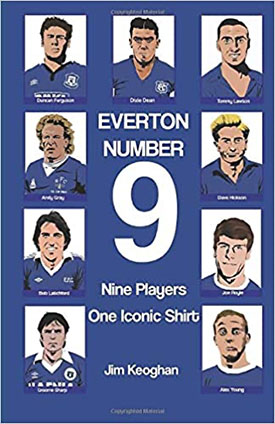
There is something about Everton and that ‘Number 9' shirt. Throughout the club's long history, so many of the club's heroes, the players who have often come to define an era or a side have worn that number on their backs.
The names run like a panoply of Goodison greats, names like Dixie Dean, Dave Hickson, Andy Gray and Duncan Ferguson, players whose exploits have become an indelible part of the club's grand narrative.
It's telling that today, in an age when shirt numbers mean nothing anymore, the era of the expanded squad reducing the positional familiarity of the old 1-11, Everton's ‘Number 9' still retains its power.
A new book by Jim Keoghan, Everton Number 9, explores the lives of nine of these figures and aims to illustrate why that is the case, to show just what they gave to this club. It is a collection of the greats, the lions of Goodison who have helped make the Everton ‘Number 9' what it is.
With one notable exception, these greats have tended to inhabit a ‘type', big, strong, unyielding; the kind of players who leave their opponents black and blue the following day. That exception was, of course, Alex Young, a player whose grace on the ball and ability to ghost past opponents earned him the incomparable nickname, “The Golden Vision”.
‘Without any doubt the finest “true” footballer it has ever been my privilege to worship. And those who were lucky enough to have seen Alex play did worship him. Our own “Golden Vision”. A title accepted immediately'
— Bill Kenwright.
Alex Young is the player who doesn't fit the mould. In the long history of the club's great number 9's, he is the outlier, the aberration. He sits uneasily amongst the panoply of Goodison greats, a forward who was not big or strong, no battering ram.
‘Alex Young was slight, nimble and delicate; someone who had the build of a winger or inside-forward,' recalls George McKane of the Everton Supporters Trust. ‘He was a one off, a supremely gifted player, the likes that you rarely see. He had a beautiful touch and could ghost past big lumbering centre-halves with ease [the kind with hairy arms and Desperate Dan chins] and had the knack to be in the right place at the right time. When you watched him in action, it was an honour.'
Young was born in 1937, in Loanhead, a mining village in Midlothian. Like many of his age and class from that area, a life at the coalface seemed to beckon and aged 15 he was taken on as an apprentice at Burghlee colliery. But for Young, his life at the mine would be short-lived. Spotted by Hearts while playing youth football, this boyhood Hibs fan was taken on by the club.
There he spent a few years dividing his time between the Burghlee and Tynecastle, a foot in both worlds. But increasingly, it was his skill with a ball that dictated the path that his life would take, saving him from a future down pit. His debut for Hearts came, aged 18, in a League Cup tie at the beginning of the 1955/56 season. Despite his tender years, it didn't take long for the fans and his manager to appreciate the young forward's talents. By the campaign's end, he was already a regular in the side and a favourite on the terraces. In five years with Hearts, Young found the net 71 times in 155 appearances, helping Tommy Walker's side to an array of silverware, including two league titles.
With a growing reputation as a forward possessed of rare skill and grace, as well as potency in front of goal, Young began to attract admirers. First, the national side came calling and in May 1960, he won his debut cap against Austria (there would be ten more). And next, teams from south of the border began sniffing around.
Although initially loath to move, Young's journey south was ultimately precipitated via a falling out with Walker. After being singled out for criticism following a languid performance against Dundee United, Young broke the habit of a lifetime and verbally retaliated. It was the beginning of the end.
When the suitors came, Everton and Preston North End led the pack, with the latter in pole position. Hearts accepted Preston's bid and Young agreed personal terms. But the move never went through, as the man himself revealed in an interview with the Everton forum, NSNO back in 2008: ‘I went to Preston and they said that they were going to give me £3000. That was a lot of money then, you could buy a house with that; plenty money. I said “well if you do that then I will come to you”; that was the first meeting. The next day, the Preston manager came again and said “the directors won't give you £3000, it's £2000”, so I said “Everton's giving me £2000, I'll go to Everton”.' And with that, in November 1960, Everton signed a Goodison legend and Preston missed out on a centre-forward who could have transformed their fortunes.
Although injuries marred his first season with the Blues, flashes of what Young could do were noted by those watching. ‘Young is a thoroughbred, a great mover with the ball, fast, active, razor sharp in his reactions' reported the Liverpool Echo after one impressive performance.
He soon got over his fitness issues and for the next three seasons was unassailable; his form breath-taking. ‘He formed a great partnership with Roy Vernon, who always has to be remembered for the work he did with Young, and the pair of them helped us reach heights that hadn't been seen at Goodison for some time,' remembers George McKane.
The pair netted 116 league goals between them over three seasons, lifting the club to the higher reaches of the table and helping Everton clinch the title in 1963, their first piece of post-war silverware and first title win in a generation. There was one goal scored by Young during the run-in that for those who followed the club at the time, will always stand out:
‘There was just a few games left and we were vying for the championship with Leicester and Spurs. We had Spurs at home in one of those games where you knew that if we won, it would give us an edge,' remembers Dr David France, the man behind the Everton Collection
67,500 people crammed into Goodison to watch that game, eager to see the Blues land a telling blow against their title rivals. Although a more open game than when they had last met, a tight 0-0 at White Hart Lane earlier in the season, there would only be one goal to separate the sides, and it arrived 20 minutes in, to the delight of the Evertonians.
‘I remember Roy Vernon, out on the wing, putting a cross into the box', recalls France. ‘There, Alex rose to meet it majestically, leaping above John Smith, the statuesque Spurs-centre half, who must have had a few inches on him. I remember his head turned through 90 degrees, eyes on the ball as it sailed past the keeper and into the net. It was a thing of beauty.'
While in his pomp during the first half of the 1960s, Young was simply sublime. As Michael Durkin reminisced on ToffeeWeb, to watch him was to be in the presence of something majestic, almost spiritual. He first saw Young on a wintry afternoon against Leeds, the nimble forward marked by two snarling defenders:
‘I can still see him in that game with two young Leeds players facing him. One of them was an aggressive young South African player named Gerry Francis. Alex killed the glistening orange ball to feet in a flurry of snow crystals and Francis snarled to his team-mate, 'Gerrim'!!! Except the tackle arrived in empty space. Alex was gone. For a microsecond the defenders looked at each other. Over the years, I got used to that look on opponents' faces. It was an almost comical combination of bafflement, fury and hapless despair. Seeing Alex play for the first time was like an epiphany. You wanted to shout 'Hallelujah!'
Young's God-like status amongst Evertonians was only enhanced by the moniker for which he would always be known, ‘The Golden Vision'. But although adopted by Evertonians, the name did not originate from within Goodison. Instead it was coined by Danny Blanchflower, captain of both Northern Ireland and Bill Nicholson's great Spurs sides of the early 1960s. In Young he believed there was something beyond football: ‘The view every Saturday that we have of a more perfect world, a world that has got a pattern and is finite,' said Blanchflower. ‘And that's Alex, The Golden Vision.'
Despite his talents, Young endured a troubled relationship with, Harry Catterick the manager who had brought him to Goodison. In no small part this was attributable the adulation given to him by the crowd. As Young later recalled: ‘It turned out that the more the fans loved me, the more the manager disliked me. I was engaged in a constant battle with Harry and learned not to trust him.'
It probably didn't help matters that during one league game, in the 1966 season, a fan ran onto the pitch holding aloft a banner that read ‘Sack Catterick, Keep Young' in response to their idol being dropped in favour of the teenage Joe Royle.
Dropped, played out of position and with rumours that Catterick was keen to cash in on his asset on more than one occasion, it appeared that Young was right to be wary. According to Rob Sawyer, author of Harry Catterick: The Untold Story of a Football Great, the Everton manager was a dour and foreboding figure, somebody unlikely to look kindly on a player being so obviously loved by the crowd. ‘He was a product of his times, a man who had grown up in the more austere environment of the 1920s and 1930s; very old school. He believed that the manager was the most important figure at the club. The players were there to do his bidding. If there was a hierarchy, he was at the top.'
Beyond the snippets available on YouTube, for those who wish to reminisce about Young's glory, or those who simply want to watch the legend in action, there is an idiosyncratic remnant of 1960s working-class drama that can sate that particular hunger. Long before Looking for Eric, there was The Golden Vision, Ken Loach's docu-drama, made for the BBC as a Wednesday Play, which focused on the historic bond between a football club and its fans. The film switches between interviews with Everton players and dramatised scenes from the lives of fans, played by local actors like Bill Dean, Neville Smith and Ken Jones.
Young, as the title suggests, is the centre of the film from the playing side. And the contrast between him and the fictitious fans is a stark one. Where their lives, centred around football, family and work, appear certain, albeit simultaneously chaotic, Young's seems to be one characterised by self-awareness, doubt and uncertainty. As a slice of working-class life, it's as good as anything Loach has ever made. And as an exploration of the role that football played, and arguably continues to play, in such communities, it's up there with the best.
But, for an Evertonian, what's more appealing is the capturing of one of the club's idols as he really was. It's easy to forget, when players are lionised and pass into immortality, that they are just people. Young's normalcy and decency, just a working-class lad trying his best, comes across. You see the man, not The Golden Vision, (despite the play's title).
Ironically, by the time The Golden Vision was made, Young's relationship with Everton was drawing to a close. The Blues were changing and the side that had been so synonymous with Young, the first that Catterick had built at Goodison, was on its way to being replaced by the one that would come to be defined by the ‘Holy Trinity' of Harvey, Kendall and Ball, and which would go on to claim the title in 1970.
But even as his relevance at Goodison started to ebb, for a time Young still remained a player who could thrill. At the close of the 1966/67 season, Everton hosted Sunderland at home. The Blues, still in transition, were on course to finish sixth. Sunderland, not long out of the second tier, were in the bottom eight but safe. There was little but pride riding on the game. Few expected much. But what they got was a pleasant surprise; an Alex Young masterclass.
‘Young beat Sunderland almost on his own that night' the Everton captain, Brian Labone, wrote in his autobiography, Defence at the Top.
From the first whistle, The Golden Vision delighted the crowd. He zipped, danced and buzzed around the pitch, linking with his team-mates, creating chances for others and accepting some for himself, as Everton dominated the visitors. Unsurprisingly, considering that he was at the heart of everything good Everton produced, Young played a part in the opener when he slid a delightful pass to Johnny Morrissey to put him one-on-one with the keeper, and Everton went 1-0 up as half-time approached.
In the second period, Everton's dominance continued and inevitably more goals arrived. The second came not long after the restart, when Young and Jimmy Husband combined well to get the ball wide to Alan Ball. His low centre was met spectacularly by Morrissey, who volleyed Everton into a 2-0 lead. Minutes later, Colin Harvey made it 3-0, converting Husband's cross (he had been threaded through by Young) to put the game beyond Sunderland.
Although the visitors pulled one back late on, it was a rare foray forward against a tsunami of Everton attacks. As the game ebbed to a close, Everton won a penalty which was converted by Morrissey. But although he had completed his hat-trick, the players wanted the match-ball to go to Young, so peerless had his performance been; a dazzling display of grace, vision and skill.
Frustratingly for his legions of fans, such afternoons became a thing of the past from then on. After that season, Young's strike rate declined and his powers appeared to wane more dramatically. Although still loved, the hints of decline that had only fleetingly been felt before became more pronounced.
In May 1968, after eight years in which he had delighted the fans, the curtain came down on one of Goodison's most cherished careers. With it evident that the club was no longer interested in his services, Young set up a potentially lucrative move to the short-lived New York Generals franchise. But once again the troubled relationship with Catterick came to impact his career. The Everton manager blocked the move and so Young found himself looking for something closer to home.
In the end he left to become player/manager with Northern Irish club Glentoran, fulfilling a long-held desire to move into coaching. Sadly, the move was brief, Young's failing hearing forcing him to step down early in his tenure. Following that stint in Northern Island, he then moved on to Stockport County where after 23 games a knee injury eventually forced his retirement aged 32.
After leaving football, Young returned to Scotland, where he lived a quiet, largely anonymous post-football existence, first running a pub, then after a spell of unemployment, buying into the Edinburgh-based upholstery firm of Richard Wylie Ltd.
If he ever tired of the anonymity, there were always reminders of his former glory on occasional trips back to Goodison, as his wife, Nancy reminisced to NSNO shortly before his death in 2017: ‘Whenever we go back to Liverpool people always recognise Alex. Hardly anybody in Scotland does or if they do, they don't let on. His status among Evertonians never fails to surprise me. It's been an awful long time now but people still adore him.'
Adoration is a rare thing at Goodison. Unlike the neighbours across Stanley Park, it is not given away easily. It has to be earned. More often than not, it's achieved through grit and determination, by players who seem willing to die for the shirt. But occasionally, as with Young, talent alone is enough.
‘Alex Young is probably the most gifted player to ever pull on the blue shirt,' argues John Bohanna. ‘And it's a testament to his talent that his name continues to be known amongst Evertonians today. He will never be forgotten. Our Alex, Golden, Visionary.'
Everton Number 9 is available in paperback and eBook form from Amazon.co.uk.
Jim Keoghan is the author of How to Run a Football Club, Punk Football, Highs, Lows and Bakayokos (Everton in the 1990s) and Everton's Greatest Games. A long-suffering Blue, Jim has been watching the club since the early 1980s, enjoying and enduring decades of pleasure and misery (mostly the latter) at Everton's hands.
 Follow @Jim_Keoghan
Reader Comments (45)
Note: the following content is not moderated or vetted by the site owners at the time of submission. Comments are the responsibility of the poster. Disclaimer
2 Posted 16/07/2020 at 10:11:15
I will be giving this book a miss. I don't think the author has done his homework.
3 Posted 16/07/2020 at 10:58:22
A friend of mine, John Grant, who played for Hibs and Scotland, used to go back to Scotland for get-togethers with other retired Internationals and he knew how highly I thought of Alex so he kindly brought me a signed photo of the great man and it hangs on my study wall today.
Thanks, Jim, for a piece bringing happy memories rather than the gloom and doom we have been reading of late. Let's hope we have more good news after the Villa game. COYB
4 Posted 16/07/2020 at 11:21:35
5 Posted 16/07/2020 at 12:30:10
Yes, but just to state how fantastic was that he repeated it in the second half v Burnley at home – I believe the goalkeeper was his cousin, Adam Blacklaw!
6 Posted 16/07/2020 at 13:52:30
Alex didn't run, he glided across the turf. He didn't turn, he pirouetted. He didn't jump, he floated. He didn't kick the ball, he caressed it. In fact, his first-touch was like a mother's tender kiss. The combination of his balletic balance, delicate feints and elegant body swerves left defenders rooted to the spot as he glided past them with astonishing economy of effort. Never ostentatious, his feet stroked the ball with the uncommon motion usually reserved for the foreheads of their newborn infants.
Probably because he had toiled in the Scottish coal-mines and served in the British Army before winning every prize in Scotland and England, Alex remained an unassuming gentleman who never displayed a hint of pretentiousness. His disinterest in self-promotion was as fascinating as his natural abilities.
George #4. we were both lucky to worship him as a hero and know him as a friend
Gerry #5. his cousin/the Burnley keeper was Harry Thomson
Younger Evertonians who never saw the great man in action should check out his 2008 biography 'Alex Young – The Golden Vision'. ISBN: 1-874799-21 and the 2016 documentary 'Alex the Great' on YouTube.
7 Posted 16/07/2020 at 14:05:15
8 Posted 16/07/2020 at 14:55:36
Back to the thread. That generation was my father's not mine. I never quite knew who his favourite was. I think it was Alex, but he often spoke equally fondly of Brian Labone and Alan Ball, who my younger brother is named after.
I know we don't have as much footage to refer to for that era, but from what I read and see, it appears Colin Harvey was one of the most underrated players of his generation. Not by Evertonians I hasten to add. I was only fortunate enough to witness him become the differentiator in Howard Kendall's first regime. Whenever I watch Howard's Way, the interviews with Colin Harvey have me welling up in nostalgic pride every time he speaks. What a competitor, what a coach, what (I can only imagine) a player and whilst maybe not a manager, what an Evertonian.
Fine article. Thank you Jim.
9 Posted 16/07/2020 at 15:41:41
As Dr France stated and that always stuck in my mind, he never run past players he seemed to glide past them, and had that amazing vision, of he new what he was going to do with the ball as soon as he got it.
With the comments going on about today's players, it is refreshing to be reminded of who, we the older generation, were privileged to see.
10 Posted 16/07/2020 at 16:03:55
When building our Everton dream teams, my dad, always included Young, Ball and TG Jones. How badly do we need talent like that today.
11 Posted 16/07/2020 at 16:34:29
I remember the day England hammered Scotland, and Scotland picked Ian St John instead of Alex, those days league games went ahead when Internationals were played. I remember Gwladys Street letting Alex know the score every time there was a corner, not to rib him just to let him know how stupid Scotland were leaving Alex out of the team. Just for the younger readers there were no substitutes in those days, so no squads just the 11 who were selected.
12 Posted 16/07/2020 at 16:40:58
13 Posted 16/07/2020 at 16:56:15
Brent (12) Alex was also advised to use his own urine to bathe his feet in, courtesy of Everton fans writing in The Echo at the time.
14 Posted 16/07/2020 at 17:00:54
15 Posted 16/07/2020 at 17:10:16
16 Posted 16/07/2020 at 17:16:23
17 Posted 16/07/2020 at 17:19:59
No, I didn't try the urine! Surgical spirits did some good for me. Even better when not taken internally.
18 Posted 16/07/2020 at 17:45:38
19 Posted 16/07/2020 at 18:08:16
Quote, "The 1962/63 season was undoubtedly Young's most effective for Everton as he forged a dynamic partnership with Roy Vernon. He even scored a brilliant glancing header against his cousin, Adam Blacklaw, the Burnley keeper in another important three one win against one of their closest rivals."
Were they wrong? I was in the fact that his 2nd header didn't go in... but it was still classy heading.
20 Posted 16/07/2020 at 20:29:11
21 Posted 16/07/2020 at 20:42:27
A superb player and he'd have been even better in the modern game.
22 Posted 16/07/2020 at 21:32:45
23 Posted 16/07/2020 at 22:03:50
24 Posted 17/07/2020 at 06:37:33
25 Posted 17/07/2020 at 15:20:56
26 Posted 17/07/2020 at 20:15:48
27 Posted 17/07/2020 at 21:30:38
28 Posted 17/07/2020 at 22:07:57
I agree with all that's been said about Alex; I've never seen a player who could glide past defenders so effortlessly and, remember, this was in the days of cut-throat defenders and mud-heap pitches. He also had this uncanny knack of being able to hang in the air to meet crosses.
I always understood Adam Blacklaw, the Burnley 'keeper, was his cousin but wouldn't argue with John or Dr David!!
The only criticism I could make of Alex was that he could sometimes disappear in away matches!
29 Posted 18/07/2020 at 10:33:56
Hi Bill [27], It was common practise for clubs to open the gates at what we used to call 'three-quarter time'. Good on you for taking that opportunity of watching the Blues.
30 Posted 18/07/2020 at 11:41:45
I could hardly speak but just said, “Thank you Alex for what you gave us.â€
His reply – “I can't thank you people for what you gave me and my family†such humility.
31 Posted 18/07/2020 at 16:55:54
32 Posted 18/07/2020 at 17:02:17
33 Posted 18/07/2020 at 17:42:21
34 Posted 18/07/2020 at 19:18:35
How about Johnnie McIllatton who played when I first started going? He was a little outside right... or Albert Julliousson, not sure of the spelling or even if he was Scottish, but he came down from a Scottish club. I think Everton got their money back on him because of a strange injury he had when they signed him.
35 Posted 18/07/2020 at 19:41:21
36 Posted 18/07/2020 at 20:09:18
Julliussen was a prolific goal scorer for Dundee, he joined Portsmouth in March 1948 scoring 4 goals in 7 games.
He was transferred to Everton in August 1948 scoring 1 goal in 10 games. Yes he was injured, I think it was before clubs provided medicals. You will recall that Liverpool had a similar problem with Des Palmer. Johnny McIlhatton was another who only played a handful of games.
You only have a few weeks to go before you become an octogenarian and you may experience the occasional lapse of memory; it's frightening isn't?
37 Posted 18/07/2020 at 21:22:17
As Eddie Canter used to sing “Keep young and beautiful, it's your duty to be beautifulâ€. I don't know about beautiful, but I do do my best to stay young; mind you, Everton have been putting years on the lot of us.
And John, it's getting closer to our release date: 1 August unless the government changes their mind, we'll feel like new men!!!
38 Posted 20/07/2020 at 01:34:09
The famous goal which against Spurs at the Gladys Street end which virtually won us the Championship came from an Alex Scott corner not a Roy Vernon ross. I was there as an 11 year old in the Boys Pen and it is etched in my memory.
Thanks
Wellzee
39 Posted 20/07/2020 at 16:07:10
As we get older our memory fades or we're certain of things that didn't actually happen and I have to inform you that your memory of Alexs' header against Spurs is wrong. It was definitely from a Roy Vernon cross. I too was there. In the Paddock. Look at the photo of the goal. There's no way that has come from a corner.
Mr Quinn (5)
It was definitely Harry Thompson who was his cousin. You're so right about his header against Burnley though. I still have a photograph of it in a scrapbook and he was so far beyond the front post it's unbelievable.
40 Posted 20/07/2020 at 17:49:32
Alex's goal against Spurs was scored from a corner taken by Roy Vernon from the corner of Gladwys St and Goodison Rd!
41 Posted 20/07/2020 at 21:41:49
Alex's goal against Spurs was scored from a corner taken by Roy Vernon from the Goodison Road and Gwladys St junction by the church.
At least, that's how my memory replays it.
42 Posted 21/07/2020 at 15:48:41
My Mother and Father (may they rest in peace) were always under the impression that it was because it was the name of my eldest brother.
Sadly I never, ever, told them the truth – I actually chose that name because of my hero Alex Young!!!!!
43 Posted 21/07/2020 at 18:55:34
No, I'm sorry. Definitely not. Vernon was out on the left wing position and curled a lovely ball in from a cross. You used to be able to see the goal on the ITV website until a couple of years ago but it's disappeared now so I can't prove it but it really was a cross from quite deep.
Never mind. We can agree to differ.
It might not have been the greatest goal Everton have scored but it's always been my favorite and I had the great pleasure of meeting Alex at his testimonial and telling him so. What a great player and a lovely man.
44 Posted 22/07/2020 at 05:43:34
The fact it comes from the left not the right would eliminate Alex Scott. For me, it was the greatest moment of my life as an 11-year-old. Thanks, guys. COYB
45 Posted 22/07/2020 at 07:51:32
My dad always said that Tommy Lawton was a great player.
Add Your Comments
In order to post a comment, you need to be logged in as a registered user of the site.
Or Sign up as a ToffeeWeb Member — it's free, takes just a few minutes and will allow you to post your comments on articles and Talking Points submissions across the site.
, placement: 'Below Article Thumbnails', target_type: 'mix' });
-sm.jpg)

-sm.jpg)
-sm.jpg)
-sm.jpg)



1 Posted 16/07/2020 at 07:45:40
Very rarely mentioned but in my eyes one of the all-time true, in every sense of the word centre-forwards. Tommy Lawton (RIP). Maybe John Mc Snr could come up with one of his super posts about Tommy? Bless you all, the tide will turn.