


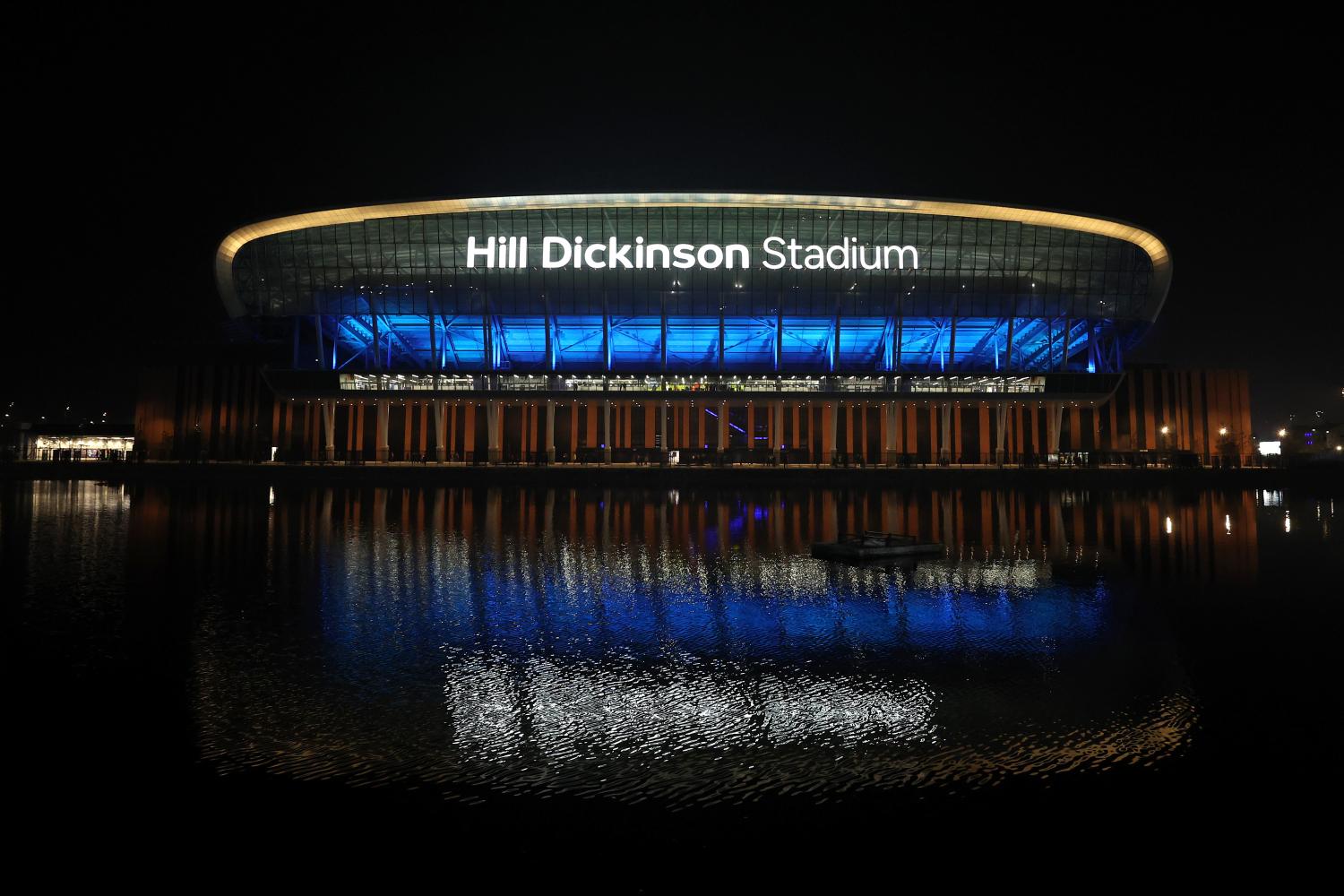
Everton's new stadium is a magnificent statement of architectural imagination and engineering enterprise brought together by design ingenuity at all levels to make this complex project a reality on the banks of the Royal Blue Mersey.
While the stunning brickwork and the steep rise of the stands capture the eye, a fascinating deep dive by Buro Happold reveals the "invisible" engineering that makes Bramley-Moore Dock a global benchmark for sustainability and heritage preservation.
Bramley-Moore Dock is a site of contrasts: rich in heritage yet exposed to the elements, offering both challenges and opportunities. From the outset, we asked the critical question: how can this environment work for the project rather than against it? That thinking drove a strategy to harness natural assets, reduce energy demand, and future-proof operations; creating a stadium that is efficient, resilient, and deeply connected to its dockside setting.
The piece linked here, titled "Harnessing the Environment: Building Lightly," outlines how the design engineers, Buro Happold, moved the project beyond simple "compliance" to embrace a philosophy where the stadium "grows" from the dock rather than simply sitting on top of it.
-
Preserving the Past, Literally: In a masterstroke of "reversible" engineering, the Grade II listed dock walls were scrupulously preserved. Instead of dredging the basin, engineers left 3 m of soft silt in place and infilled over it with layers of sand. This saved 75,000 m³ of infill (enough to fill 30 Olympic-sized swimming pools) and means that, theoretically, the dock could be returned to its original state in the future.
-
Harnessing the Elements: The stadium isn't just shielding fans from the elements; it's using them. Over 2,000 m² of solar panels (PVs) are integrated into the roof, paired with a battery storage system to manage peak demand and ensure the "Blue" energy generated on-site is used intelligently.
-
A "Football First" Climate: The article details the exhaustive wind tunnel testing required to ensure the exposed dockside location didn't result in a "wind tunnel" effect for fans. Through precise digital simulation, the team designed landscape mitigations to protect supporters while maintaining the "cauldron" atmosphere inside.
-
Eco-Innovation: From rainwater harvesting for pitch irrigation to the installation of "cormorant rafts" and pollinator-friendly planting, the project has maintained a hydraulic link between the docks to protect the local ecosystem.
For Blues interested in the "how" behind our new home, this article is a must-read. It proves that the "People’s Project" isn’t just a slogan — it’s an engineering reality that respects our city's maritime history while looking firmly toward a sustainable future.
» Read the full article at Harnessing the Environment: Building Lightly, from Everton’s Vision to Engineering Reality
Reader Comments (12)
Note: the following content is not moderated or vetted by the site owners at the time of submission. Comments are the responsibility of the poster. Disclaimer ()
2 Posted 01/04/2026 at 15:21:43
The article says this: Buro Happold led the embodied carbon assessment and strategy, while Laing O'Rourke brought its expertise in off-site manufacturing and low-carbon construction to deliver measurable reductions.
Gone are the days when a good old Consulting Engineer, like Binnie & Partners or Ove Arup, would do everything to make the architect's concept a reality.
Mind you, I fell out with Binnies early on in my career, when I was very young geotechnical engineer for a contractor and they were very much cards close to the chest, keeping me in the dark and throwing shit in my direction.
3 Posted 01/04/2026 at 17:29:27
This is NOT a news article. It's a self-promotional marketing piece written by Buro Happold.
Granted, it's beautifully written -- as a PR guy myself I appreciate a well-crafted puff piece, and the BH marketing team deserves dinner out for this one -- but an advertisement should not be presented as news on TW.
Suggest you look again at this decision.
4 Posted 01/04/2026 at 19:37:20
You may not believe in Environmental Conservation over in the US but I found that article very informative.
I am very proud that our new home considered not only the environmental impact of the construction on a heritage site during the design concept but also the impact of the environment on the fans (although they could have provided better rain protection) and the adoption of renewable energy technology to reduce day-to-day energy costs.
5 Posted 01/04/2026 at 22:43:28
For rather pathetic technical reasons, pretty much everything now gets posted as News -- at least initially -- otherwise, it would effectively be hidden and you probably wouldn't get to read it.
That said, we don't have a category for 'self-promotional marketing blurb'. I thought it gave a different spin on some aspects of construction I've not seen before, and thought it might be of interest to some... (Thanks, Neil!)
Anyway, we put stuff up because it's about Everton... not because it's 'News' per se.
6 Posted 02/04/2026 at 02:48:50
7 Posted 02/04/2026 at 02:51:05
8 Posted 02/04/2026 at 08:06:19
Neil, it was certainly interesting, although personally I would have found it more interesting had it addressed more thoroughly the regulatory and logistical challenges of executing on the environmental plan, and had it been a bit less self-promotionally gushy. I’m sure the first time I see the place. I will take similar pride in how well the stadium is environmentally integrated. I just thought it was important to point out that it was essentially a press release and could by no means be considered a news article.
9 Posted 02/04/2026 at 09:08:49
There are also some other articles on there about how the mitigation against the wind was implemented.
Not news as such but still valid to post.
10 Posted 02/04/2026 at 09:57:13
Can't understand anyone carping about it???
11 Posted 02/04/2026 at 19:46:51
My initial paragraph was tongue in cheek but what I did find interesting was the strategic thinking in the design of the stadium:
1. Respecting the past heritage of the site
2. Designing the stadium to minimise the impact of local environmental conditions.
3. Future proofing against future environmental shocks.
This was done at a time when there was no strategic planning in Everton Football Club.
Hopefully our new owners will follow the same shrewd strategy in their football and financial strategic planning.
12 Posted 04/04/2026 at 15:06:05
Add Your Comments
In order to post a comment, you need to be logged in as a registered user of the site.
Or Sign up as a ToffeeWeb Member — it's free, takes just a few minutes and will allow you to post your comments on articles and Talking Points submissions across the site.
How to get rid of these ads and support TW


-sm.jpg)
-sm.jpg)
-sm.jpg)
-sm.jpg)


1 Posted 01/04/2026 at 14:54:41
Weren't Laing O'Rourke the builders then?