


When one thinks of the archetypal Everton goal, then the image that immediately springs to mind is of a ball whipped dangerously into the box, and a centre-forward or centre-back meeting it with a towering, powerful header.
The back of the net bursts; the crowd behind roars. And invariably, it would be from a set-piece. Maybe a free-kick, but more likely a corner.
Think Duncan Ferguson against Manchester United in 2005. Or any number of goals scored by Tim Cahill. Or Dominic Calvert-Lewin against Liverpool at the Gwladys Street in 2024, or two years earlier, when his diving header completed that stunning comeback against Crystal Palace.
But this season, and indeed, since David Moyes returned, Everton’s set-piece threat really seems to have nosedived.
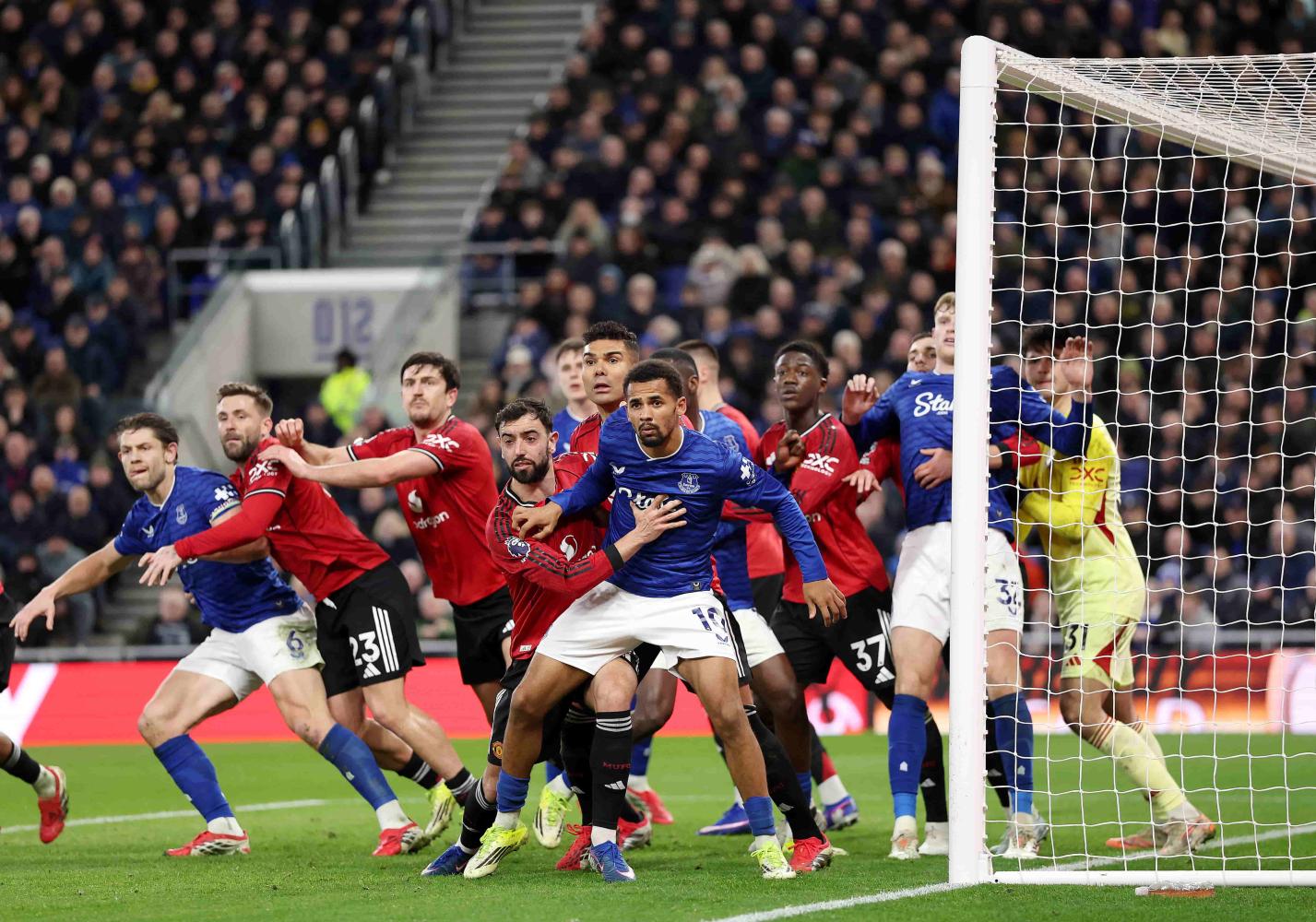
There was no better example than on Monday, as Everton won 10 corners against Man Utd at Hill Dickinson Stadium.
That is their joint-highest total in a single Premier League game this season, along with the 10 they won against Aston Villa in September.
Yet as chaos reigned on Senne Lammens’ goal-line, with Everton’s big men getting embroiled into something resembling a Royal Rumble rather than freeing themselves up to be targets, time and time again, James Garner and Kiernan Dewsbury-Hall simply planted floated deliveries right onto the top of United’s goalkeeper, or if not, onto the head of Harry Maguire or Leny Yoro.
Everton’s approach seemed to have been based on Lammens having issues dealing with crosses. Having watched United a fair bit this season, I have to question just quite what Everton’s coaches had seen to suggest the big Belgian would flap under the pressure.
And this speaks to the big question. Why, in a time when set-pieces have been as important to success in the Premier League as they ever have been, are Everton’s so predictable and lacking in invention?
Under Sean Dyche, Everton were hugely reliant on set-pieces. Dwight McNeil would look to pick out James Tarkowski at the back post, and that would cause mayhem. Teams knew what was coming, but couldn’t stop it.
By the end of Dyche’s tenure, that approach had started to stagnate, but still, Moyes has always had big presences, and he regularly plays with three centre-backs (sometimes even four). Everton, by all rights, should be one of the most dangerous set-piece teams in the division. Instead, they are distinctly average.
Now, a look at the numbers does paint a slightly prettier picture. Of Everton’s 31.49 xG in the league this term, 11.6 has come from set-piece situations. However, set-pieces are not just counted as the initial ball in — data providers also count the second phase. So, for example, Beto’s goal against Wolves in August, when Vitaliy Mykolenko recycled possession after a cleared set-piece and found Jack Grealish, who laid it on a plate for the striker, will count as a set-piece goal.
The issue with Everton is often the initial delivery or execution. Too often, crosses are lacking in pace. The ones that have been drilled in flat have resulted in goals — Michael Keane against Fulham at home, Bernd Leno palming into his own net at Craven Cottage. These spring to mind.
Everton, though, have scored just seven goals from set-piece situations. Wolves (5) rank bottom of the competition in that metric, while it is unsurprisingly Arsenal who lead the way, with 17.
Those are just high-level statistics, but it is clear that there are issues. Moyes will probably point to Everton’s set-piece xG as evidence they can create chances from them, yet to the eye test, Monday’s example against United was simply an amalgamation of a problem well over a year in the making.
Everton do not have a specialist set-piece coach. This time last year, former Liverpool midfielder Charlie Adam was hired to fill the remit, but Adam had no specific background in set-pieces (albeit, he could take a good one). Predictably, it did not work out.
But Everton did not move to replace Adam. Instead, the club seems to have given it up as a bad job. Never mind that two of the top three teams in the league at the moment have specialist set-piece coaches (one of them even has a mural outside the Emirates, for goodness sake!), Moyes decided to take it in-house.
It is this inward thinking that can be especially grating. Everton have gone with the trend this season — they insist on taking long throws, despite the fact they are awful at them. They insist on rugby-like tactics from corners, despite it never really working.
They have three-to-four huge centre-backs on the pitch at any one time, plus two strikers who are over six foot, yet they are either nowhere near the ball or, if they do meet it, tend to send free headers over from close range.
The art of the set-piece should not be lost on Moyes, and in his first spell in charge, they were a brutal weapon in Everton’s armoury. Now, they seem stale.
Moyes needs to be willing to think outside the box, and to seek external assistance. It is nothing to be ashamed of. It is a marginal gain that could be the difference between European qualification or not.
And what of the club? With no sporting director in place, does anybody have the authority to challenge Moyes if he is refuting the suggestion Everton’s coaches perhaps need some assistance in this area? Is this where the committee structure, pushed for by CEO Angus Kinnear, has a major weakness?
It would not be such an issue if Everton were creating chances regularly from open play, but across the last 18 league matches, only once have the Toffees recorded over 1.0 open-play xG.
Right now, it’s a bit like having the worst of both worlds.
It is not all on the coaches. There is only so much Moyes and his staff can work on — it is then on the players to execute, and it is also on the players to have the common sense to instill some variety, rather than try the same thing over and over, even when it is not working.
But all Evertonians want to see more goals, and they do not come much better than the typical, traditional Everton goal that we all know and love. To get there, maybe the powers that be just need to try something new?
Reader Comments (15)
Note: the following content is not moderated or vetted by the site owners at the time of submission. Comments are the responsibility of the poster. Disclaimer ()
2 Posted 28/02/2026 at 08:41:22
3 Posted 28/02/2026 at 09:03:49
There needs to be variety. Change of routine. Other clubs do it. Not against us, of course. We can't defend the basic one. But 10 corners and no chance created just a load of shoving and pushing in the 6 yard box is pathetic.
4 Posted 28/02/2026 at 09:06:28
Plums
5 Posted 28/02/2026 at 09:12:25
6 Posted 28/02/2026 at 09:24:19
Patric, I doubt if you were old enough to see him but Dave Hickson was a brilliant header of a ball and was a decent footballer, he could rattle and upset opposition defences — think Duncan Ferguson — but every game, not just the big ones.
Charlie Adam was just getting a favour off an old friend, not a bad 6 month touch. Moyes's son is getting one now, don't know how long that will last.
7 Posted 28/02/2026 at 09:34:41
I don't know whose intelligence you are trying to insult with that type of statement because anyone who has got any understanding of football would simply ask the question, why?
Why is it so hard get a message on? Seriously, enlighten me, why is it so hard to get a message on?
They never got a message on either to get more defenders back instead of letting Michael Keane expose himself by being one-on-one with a Man Utd forward, even though it was something our manager had said he was aware might happen.
By the way, why can't footballers think for themselves either? Usually when they have got a very set in his ways, Sergeant Major in charge, maybe?
8 Posted 28/02/2026 at 10:19:30
The players are shaped in his image. Even with 7'5" Dan Burn on their side, they'll try the same ridiculous non-football barging and pushing. They should go the whole hog and just scrum down, it's a joke, embarrassing.
9 Posted 28/02/2026 at 10:41:53
10 Posted 28/02/2026 at 14:18:43
Be fair Moyes it's really not hard to get a message on.
11 Posted 28/02/2026 at 14:29:54
Any fan with half a brain could make at least 5 obvious tweaks that would improve this team in the blink of an eye. Moyes apparently cannot.
12 Posted 28/02/2026 at 14:34:47
We have some of the tallest players in the Premier League that are not being utilized properly. Monday night's corner tactics were a disgrace.
13 Posted 28/02/2026 at 14:35:04
When the full-back takes a throw-in from in front of the dugouts... "Tell Garner and KDH to vary the corners!"
He is lying, mate.
14 Posted 28/02/2026 at 17:14:33
A: Jarrad Branthwaite!!!!
15 Posted 02/03/2026 at 08:19:26
Watching the Arsenal vs Chelsea match, it isn't a good look for the Premier League. But it will continue until it is stopped.
Add Your Comments
In order to post a comment, you need to be logged in as a registered user of the site.
Or Sign up as a ToffeeWeb Member — it's free, takes just a few minutes and will allow you to post your comments on articles and Talking Points submissions across the site.
How to get rid of these ads and support TW


-sm.jpg)
-sm.jpg)
-sm.jpg)
-sm.jpg)


1 Posted 28/02/2026 at 08:33:02
Might take some time, Patric.